|
Clear Penetrating Epoxy Sealer™ (CPES™) consists
of a tough, flexible resin system in a solvent blend which
dissolves the sap, oil and moisture found in wood. The resin
system is derived from natural wood resin and develops a
chemical adhesive bond to the wood fibers themselves.
The wood is strengthened while allowing normal expansion and
contraction with changes in temperature and humidity.
When repairing wood that has mild dry rot, the CPES will migrate
along the abnormal porosity which dry rot fungus creates within
the wood, as long as it continues to be fed in. Impregnation of
wood with CPES changes the cellulose of wood (which fungi and
bacteria find tasty and easily digestible) into
epoxy-impregnated cellulose which resists further attack by
fungi and bacteria while reinforcing the wood, accomplishing
restoration.
Paint or varnish will last longer because the paint has a
strongly attached, chemically compatible surface to bond onto.
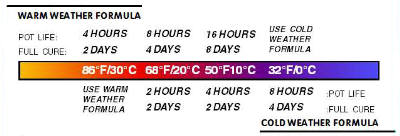
The long working time (pot life) of these
products mean they will retain their penetrating and
moisture-dissolving ability for more time.
Read and follow application instructions. Keep rain or dew away
from areas being treated with CPES until solvents have
evaporated out of the wood. This will take at least a day and
may take a week or more, depending on the extent of
deterioration, how deeply the CPES soaked in and the
temperatures day and night.
Application may be by brush, roller or immersion. Spraying is
not recommended as a portion of the solvent component will
evaporate in transit, and it is important that the product be
applied to the wood in the same formulation furnished
originally. When applying by roller on a vertical surface, hold
the roller only horizontally and slowly roll only upwards. When
treating rot inside sound wood, drill a hole that intersects the
rot, glue a funnel in the hole, and use the Cold Weather Formula
to impregnate the region. Allow sufficient time for solvents to
diffuse and evaporate out of the wood before applying fillers or
glues. Removing paint from all sides of wood to be treated
speeds solvent evaporation, as does moving air.
CPES is also a consolidant for old, crumbly concrete or mortar
between bricks, and is an essential component of effective
osmosis blister treatment on fiberglass boats.
Our Epoxy Cleanup Solvent. will clean up any epoxy product
before it cures. Once cured, no clean-up solvent is effective.
Working in cooler weather?
Use our Cold
Weather Formula
The Cold Weather Formula™ of Clear Penetrating
Epoxy Sealer was developed because sometimes repairs such as
restoration of deteriorated wood, repair of osmosis-damaged
fiberglass boats, and/or adhesion-promoting priming for sealants
or coatings must be done in the winter.
The particular kind of resins that must be used in Clear
Penetrating Epoxy Sealer in order to obtain all its usual
performance features, which have made the product famous, do not
cure well below about 50° F and essentially stop curing by 40°
F. This is a normal characteristic of these products, and has
been well known to chemists for half a century. If used in cold
weather, after a few days they cure in an incorrect manner and
do not develop optimum properties in the wood.
Early in 1991 the genius in the research department of Smith
& Co. discovered the fundamental reason why this is so, and
discovered the Dual Synergistic Catalyst which makes it possible
for these resin systems to develop a full and predictable cure
at temperatures down to 28° F, slightly below freezing!
The entire formula was redesigned to take advantage of this
new technology. The new formulation behaves essentially the same
in freezing weather as the Warm Weather Formula™ does in
moderate weather. The Cold Weather Formula was designed to
absorb as much water as the existing system does from wood or
osmosis-damaged fiberglass laminate, and in addition to dissolve
the ice crystals that form in damp materials subjected to
below-freezing conditions.
The product line was further improved in 2001 when the
solvent formulation was upgraded to give a 50% increase in
moisture-dissolving capabilities.
Clear Penetrating Epoxy Sealer will prevent freeze-thaw damage
to concrete. This surprising performance was discovered by a
customer in Finland and verified by the National Testing
Institute.
The Cold Weather Formula of Clear Penetrating Epoxy Sealer
mixes one-to-one by volume as does the Warm Weather Formula.
Once mixed, it is recommended that the product be used within
its "pot life", although it will be fluid for much longer.
The Cold Weather Formula of Clear Penetrating Epoxy Sealer (CPES)
was designed to be used in the temperature range of 28° F - 65°
F. The table of pot life and full cure times on the next page
illustrates this.
It is a necessary part of the wood restoration
process that the solvents be allowed to evaporate out of the
wood before paint or filler is applied. The solvent blend in the
Cold Weather Formula evaporates about as fast in cold weather as
the solvent blend in the Warm Weather Formula does in warm
weather.
The solvent blend of the Cold Weather Formula has a milder
odor, as well as evaporating about six times faster. These
features allow restoration work to be completed sooner and to be
done in the winter, when most products do not work properly.
Restoration of wood inside a house, such as in a bathroom, a
door threshold or the inner part of a window sill, should be
done with the Cold Weather Formula rather than the Warm Weather
Formula when the house is occupied, due to the much milder odor
and more rapid solvent vapor dissipation of this version.
Nighttime temperatures are usually much less than daytime
temperatures and so night provides less progress towards full
cure than day. This makes the Cold Weather Formula valuable when
the daytime temperatures are in the 50° F ~ 60° F range and/or
night temperatures are in the 30° F ~ 40° F range.
Copyright ©
2005 Steve Smith all rights reserved |